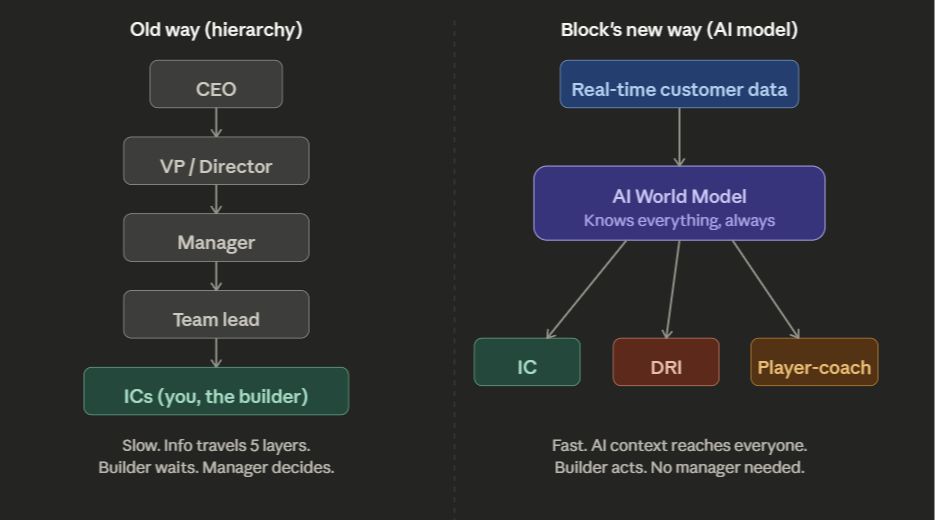
Managers are Going away from IT Landscape
The Big Idea in one line:
Block (Jack Dorsey's company) is replacing managers and org charts with AI. Instead of humans routing information up and down a chain, an AI "world model" does it.
Point 1 — The old way: Army-style hierarchy
For 2000 years, every big organization worked like the Roman Army:
- 8 soldiers → 1 leader
- 10 leaders → 1 bigger leader
- and so on...
Your example: Imagine your school. You → Class teacher → HOD → Principal → Management. Every layer exists just to pass information up and down. That's literally it.
The problem? More layers = slower decisions. By the time the message reaches the top, it's already outdated.
Point 2 — Companies copied the army
Railroads, then corporations, then every tech company used the same structure. Managers exist primarily as information routers — they collect updates from their team, summarize it, pass it up.
Your vibe-code example: It's like if every console.log in your app had to go through 5 wrapper functions before printing. Same info, just slower and noisier.
Point 3 — Everyone tried to fix it, nobody could
- Spotify tried squads → had to go back to normal management at scale
- Zappos removed all managers → people quit
- Valve had zero hierarchy → couldn't scale past a few hundred people
Why? Because removing managers left a gap — who coordinates? There was no technology powerful enough to replace what humans were doing.
Point 4 — Block's bet: AI is that technology
Block is saying: "What if AI is the manager?"
Instead of a manager knowing what each team is doing and relaying it — an AI "world model" tracks everything in real time:
- what's being built
- what's blocked
- where resources are going
- what's working
Your example: Imagine your vibe-coded project had an AI that always knew which function was broken, which feature was 80% done, what the user was complaining about — and could tell any team member exactly what to work on without a PM or manager in the loop.
Point 5 — Block has a secret weapon: financial data
Their "customer world model" is built on real transaction data from Square (seller side) + Cash App (buyer side). Every rupee/dollar spent is a signal.
Why this matters: Surveys lie. Ads get ignored. But spending behavior is truth. If a merchant's revenue drops every November, the AI already knows — and can offer a loan before the merchant even thinks to ask.
Point 6 — The new org has only 3 roles
Instead of a 10-layer hierarchy:
- ICs (Individual Contributors) — just build stuff. No waiting for manager approvals.
- DRIs (Directly Responsible Individuals) — own one specific problem for 90 days, with full authority to pull resources. Like a temporary squad leader.
- Player-coaches — senior people who still write code and mentor. Not full-time managers.
Your example: In your YouTube channel, you're basically all three already — you build, you own the content strategy, and maybe you help someone else learn. Block is making an entire company work like that.
Point 7 — The roadmap writes itself
Traditional: PM guesses what to build → builds it → hopes users want it.
Block's way: When the AI intelligence layer tries to compose a solution for a customer but can't because the feature doesn't exist → that failure becomes the next thing to build.
Your vibe-code analogy: It's like your AI copilot saying "I tried to do X for the user but there's no API for it" — and that error message is your product backlog.